Orthodontics
Orthodontics and Braces in Vile Parle East, Mumbai.
Braces carry a reputation built almost entirely on the experience of getting them as a teenager, the brackets, the tightening, the dietary restrictions, the years of waiting. For children it's become unremarkable. For adults considering them for the first time, or reconsidering them after putting it off for years, the mental picture is usually still that teenage one, and it's often enough to stop the conversation before it starts.
The practical picture is different. Braces work at any age where the teeth and bone are healthy. Adult orthodontic treatment is more common now than at any point in the past, in a city like Mumbai where professional appearances matter and where the generation that grew up without access to orthodontic treatment now has both the means and the motivation to address alignment issues they've been living with for decades. At Designer Smiles in Vile Parle East, orthodontic treatment for both children and adults is supervised by our specialist orthodontist, a dentist with dedicated postgraduate training in this specific area, not a general dentist picking up alignment cases on the side.
- Duration
- Typically 12 to 24 months depending on the case
- Sessions
- Initial assessment, fitting, then adjustments every 4 to 6 weeks
- Price
- Personalized after orthodontic assessment
01 / Overview
What Is Orthodontic Treatment?
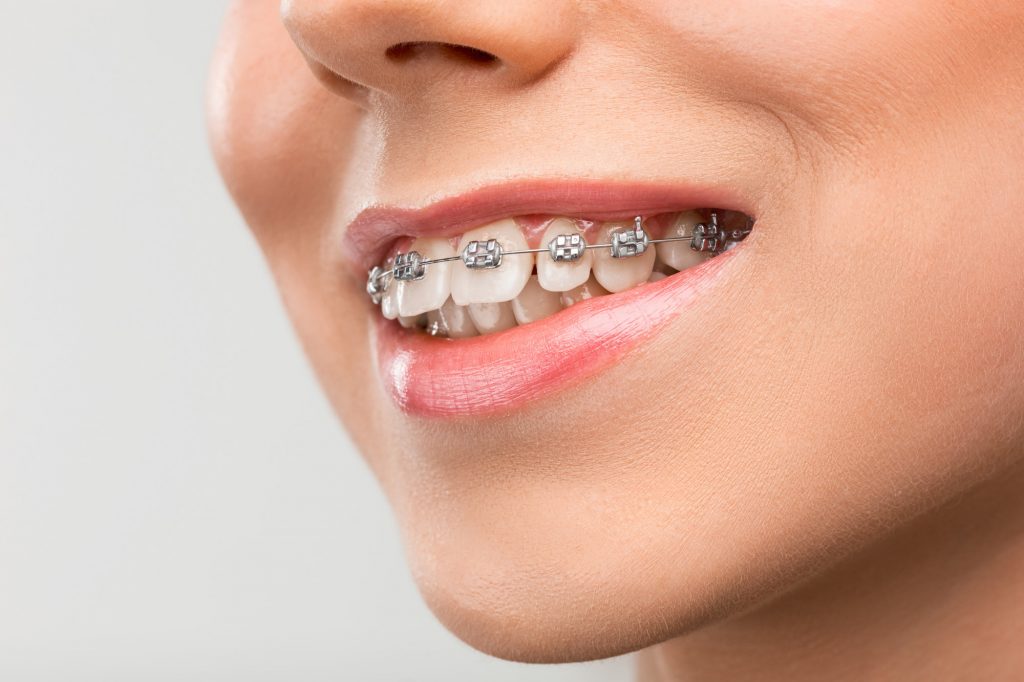
Orthodontic treatment uses appliances, most commonly braces, to move teeth gradually into better alignment and to correct bite problems. The appliances apply consistent, controlled pressure over months, and the bone surrounding the teeth slowly remodels to accommodate the new positions.
The goal of orthodontics is both functional and aesthetic: straighter teeth are easier to clean (reducing the long-term risk of decay and gum disease), a corrected bite reduces uneven wear and jaw joint strain, and the visible result of a better-aligned smile is something most patients find more significant than they expected.
02 / Indications
What Problems Does Orthodontic Treatment Address?
Crowded teeth. Where there isn't enough space in the arch and teeth overlap, rotate, or sit in front of each other.
Gaps between teeth. Spaces caused by a discrepancy between tooth size and jaw size, or from missing teeth.
Overbite. Where the upper front teeth extend too far over the lower ones vertically.
Underbite. Where the lower teeth sit in front of the upper teeth when the mouth is closed.
Crossbite. Where some upper teeth sit inside the lower teeth.
Open bite. Where upper and lower front teeth don't meet when the mouth is closed.
Deep bite. Where the upper teeth excessively cover the lower teeth, sometimes causing them to bite into the roof of the mouth.
Jaw discrepancies in growing children. Where the upper and lower jaws are developing unevenly, early orthodontic intervention can redirect jaw growth during the window when the bone is still forming, producing outcomes that are not achievable once growth is complete.
03 / Types
Metal, Ceramic, and Self-Ligating Braces: Which Is Right for You?
At Designer Smiles, orthodontic treatment is offered with several brace types. The right choice depends on your clinical case, lifestyle, and priorities.
Metal Braces. The most established orthodontic appliance, and still the most effective for handling a wide range of alignment and bite issues, including complex cases. Modern metal braces are smaller, lower-profile, and more comfortable than the versions most adults remember from school. They are also the least expensive option. The only limitation is visibility: metal brackets and wires are noticeable at a normal conversational distance.
Ceramic Braces. The same mechanism as metal braces but with tooth-coloured or clear ceramic brackets, significantly less visible than metal. The wire running between the brackets is still metallic, though tooth-coloured coated wire options reduce visibility further. Ceramic braces handle a similar range of cases to metal, but require slightly more care to avoid staining the ceramic over a long treatment.
Self-Ligating Braces. A variation of fixed braces, available in both metal and ceramic, that uses a built-in sliding mechanism to hold the wire rather than the small elastic ties used in traditional braces. Self-ligating braces produce less friction between the wire and bracket, which some patients find reduces overall treatment time and requires fewer adjustment appointments. Whether the clinical difference justifies the additional cost depends on the individual case and is something the orthodontist will advise on at the consultation.
Clear Aligners. For patients whose cases are suitable, removable clear aligners offer the option of orthodontic treatment without any fixed appliance. The Clear Aligners page covers this in full, including an honest comparison of when braces are still the better clinical recommendation despite the appeal of clear aligners.
04 / Adults
Can Adults Get Braces?
Yes, and in significant numbers. The biology of orthodontic tooth movement doesn't change meaningfully with age: as long as the teeth and gum and bone tissue are healthy, teeth can be moved at any age. Adults who get braces do so for a wide range of reasons: addressing alignment issues they never got the chance to fix as children, correcting relapse after earlier orthodontic treatment where retainers weren't worn consistently, improving bite function that's been causing discomfort or uneven tooth wear, or simply deciding that their thirties or forties are as good a time as any to make a change they've been considering for years.
The two things that are genuinely different for adult orthodontic treatment compared to treating children and teenagers: the bone is fully set, meaning jaw expansion and growth guidance is no longer an option, and any existing dental work (crowns, implants, bridges) needs to be factored into the treatment plan from the start. Neither of these makes orthodontic treatment impossible for adults, they're simply things the assessment takes into account.
05 / Children
What Is the Right Age for a Child's First Orthodontic Consultation?
The standard recommendation worldwide is that children see an orthodontist for the first time around age seven, while the baby teeth are still present and the permanent teeth are beginning to come in. At this age, the jaw is still growing and certain developing issues, crowding, crossbites, bite problems related to jaw development, can be identified and sometimes addressed during the growth window in ways that significantly reduce the complexity of treatment later.
An assessment at seven doesn't necessarily mean treatment starts at seven. For many children, the conclusion of an early evaluation is simply to monitor and wait for the right point in dental development before any appliance is placed. The value is in not missing the window where intervention is most effective.
At Designer Smiles, paediatric dental care is handled in coordination with the Children's Dentistry provision, and orthodontic assessments for children can be arranged as part of that care pathway.
06 / Process
What to Expect During Orthodontic Treatment
- Orthodontic Consultation and Assessment. Clinical examination, digital X-rays (including a lateral cephalometric X-ray to assess jaw relationship in more complex cases), and photographs are taken. The specialist orthodontist reviews the findings and presents a treatment plan: the type of brace recommended, the estimated treatment duration, and any preparatory steps needed, such as extractions to create space before braces can be fitted.
- Preparatory Work (if needed). Some cases require one or two teeth to be removed to create enough space for the remaining teeth to align properly. This is planned and discussed at the consultation stage, not sprung as a surprise.
- Brace Fitting. Brackets are bonded directly to the teeth and the arch wire is placed through them. The fitting appointment typically takes one to two hours. There is usually some mild soreness for a day or two afterward as the teeth begin to respond to the pressure, this is normal and expected.
- Adjustment Appointments. Every four to six weeks, the arch wire is adjusted or replaced to continue guiding tooth movement. These appointments are shorter than the fitting, typically twenty to thirty minutes.
- Debonding and Retainers. When the teeth have reached their target positions, the brackets are removed and the teeth are polished. Retainers are fitted immediately. This is not the end of treatment, it is the transition to the retention phase, which is arguably the most important phase of the entire process.
07 / Retention
What Happens After Braces Are Removed?
The retention phase is the part most orthodontic content treats as a brief footnote. It shouldn't be. Teeth have a natural tendency to drift back toward their original positions after orthodontic treatment, driven by the memory of the surrounding bone and the pull of the surrounding soft tissues. This drift is slow, gradual, and entirely preventable with consistent retainer wear, and entirely irreversible once it has happened significantly.
Retainers are worn full-time initially, then typically just at night on a long-term basis. Exactly how long retainers need to be worn is a question with one honest answer: indefinitely, at least for night wear. The patients who experience significant relapse years after treatment are almost always the ones who stopped wearing their retainers after the first year or two.
This isn't meant to discourage anyone from orthodontic treatment, the results of well-planned braces, maintained properly, genuinely do last. It's meant to set the expectation clearly before treatment begins rather than after.
08 / Your Visit
Your Experience at Designer Smiles
Orthodontic appointments range from the longer initial fitting to the shorter routine adjustment visits every four to six weeks. At Designer Smiles, the same standards apply throughout: a private operatory, clear communication, relaxing music, and the signature warm towel and neck and face massage after each visit. For a treatment that spans twelve to twenty-four months, the environment in which those monthly visits happen is not a trivial consideration.
Why Designer Smiles
Why patients in Vile Parle, Andheri, and across Mumbai choose Designer Smiles.
- 01Specialist orthodontic supervision throughout. Orthodontic treatment at Designer Smiles is supervised by our specialist orthodontist, a dentist with dedicated postgraduate training in this area, not a general dentist handling alignment cases as an extension of broader dental practice. From the initial assessment and treatment planning through every adjustment and the final retainer fitting, the same specialist is responsible for the outcome.
- 02A full range of brace types. Metal, ceramic, self-ligating, and the option of clear aligners for suitable cases, means the recommendation is made based on what's clinically appropriate for your alignment issue and your lifestyle, not limited by what the clinic happens to offer.
- 03Honest advice on braces versus aligners. Where traditional braces would produce a better clinical result than clear aligners, that is the recommendation given. Where aligners are clinically appropriate and the patient's preference, they are offered. The assessment determines the recommendation, not the other way around.
- 0430+ years of clinical experience under Dr. Kavita Bhat Kumar's oversight. Designer Smiles has been treating patients in Vile Parle East since 1995. ISO 9001:2015 certified. Famdent Excellence in Dentistry Award (Highly Commended, Clinic of the Year 2021). Dr. Kavita has held office within the Indian Dental Association, the body upholding professional and ethical standards for dentists nationwide.
- 05Easy to reach from Andheri, Santacruz, and across the western suburbs. The clinic is in Vile Parle East, close to Vile Parle railway station on the Western Line.
FAQ
Common questions about orthodontics & braces.
Related
Treatments often considered alongside Orthodontics & Braces.
Book Your Consultation
Ready to Start?
A consultation with our specialist orthodontist is the right first step, for children, adults, or anyone reconsidering a decision they've been putting off.